
Foreign Affairs
Poland votes in knife-edge presidential election pivotal to nation’s EU path

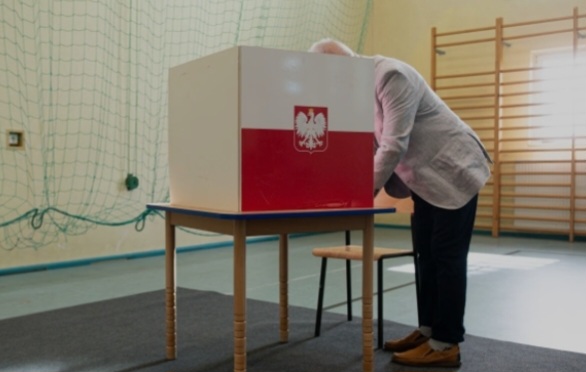
Voting was underway across Poland on Sunday in one of the most consequential presidential elections since the fall of communism—one that could define the country’s place in Europe for years to come.
With the race between centrist incumbent Rafal Trzaskowski and nationalist challenger Karol Nawrocki too close to call, political tensions are running high in the EU’s sixth most populous nation.
Polls opened at 7 a.m. local time and will close at 9 p.m., with turnout expected to play a decisive role in what analysts are calling a “referendum on Poland’s future direction.”
Trzaskowski, affiliated with the pro-European Civic Coalition (KO), is seeking a second term. His opponent, Nawrocki, a historian and head of the Institute of National Remembrance, is backed by the conservative-nationalist Law and Justice party (PiS).
Though Trzaskowski has maintained a slender lead in recent opinion polls, the margin remains within the statistical error, with undecided voters and rural turnout likely to sway the result.
The election is widely viewed as a choice between remaining anchored in the liberal democratic traditions of the European Union or shifting toward a populist-nationalist model reminiscent of Donald Trump’s “Make America Great Again” movement.
Trzaskowski, the 52-year-old mayor of Warsaw, has vowed to strengthen ties with Brussels, defend democratic norms, and support reproductive rights and judicial independence.
His reelection would consolidate the centrist grip on both the presidency and parliament for the first time in a decade.
“This is about whether Poland remains a reliable European partner or retreats into isolation,” Trzaskowski told supporters during his final campaign rally in Kraków on Friday night.
“We must choose unity, law, and democratic values.”

In contrast, Nawrocki, 43, has campaigned on a platform of “national renewal,” vowing to protect traditional values, oppose immigration quotas, and resist what he describes as “EU overreach.”
His campaign has leaned heavily into culture war rhetoric, warning against what he calls the “Western moral decline.”
“This election is our last chance to defend Polish sovereignty from foreign ideologies and cultural decay,” Nawrocki declared at a rally in Białystok.
The outcome will shape not only Poland’s domestic trajectory but also its role within the EU, where Warsaw has often clashed with Brussels over judicial reforms, media freedom, and LGBTQ+ rights during the PiS-led governments of the 2010s and early 2020s.
Since Civic Coalition ousted PiS from parliamentary power in late 2023, tensions have simmered, with the presidency the last bastion of conservative influence.
A Nawrocki win could frustrate government efforts to reverse controversial judicial appointments and reassert control over state media.
Turnout may prove decisive, especially among younger voters and Poles living abroad, who tend to lean pro-European. Polling stations reported steady queues in major cities by midday, while the national election commission noted a turnout rate of 28.4% by 12 p.m.—a figure on par with past high-stakes votes.
Preliminary exit polls are expected shortly after voting ends, with official results likely by Monday morning.
For now, the eyes of Europe—and the world—remain fixed on Poland, where the battle between liberal democracy and rising nationalism is playing out at the ballot box.







 News2 days ago
Outrage as mortuary attendant caught using human leg as walking stick in Benue
- News2 days ago
Edo security operative escapes from kidnapper’s den, frees 2 others
- Special Features2 days ago
7 practical ways of purifying water safely at home
- Politics1 day ago
APC support groups in Ondo reject State directive, back Tinubu ahead of 2027
- News2 days ago
APC accuses gov Adeleke of withholding LG salaries in Osun
- News2 days ago
Atiku meets Adamawa ADC stakeholders in Abuja ahead of 2027
- News2 days ago
JAMB officially releases Thursday’s UTME results, see how to check score
- Politics1 day ago
2027: ADC is only party capable to unseat Tinubu – Atiku



You must be logged in to post a comment Login