
News
Judges, lawyers locked out as judicial workers begins indefinite strike

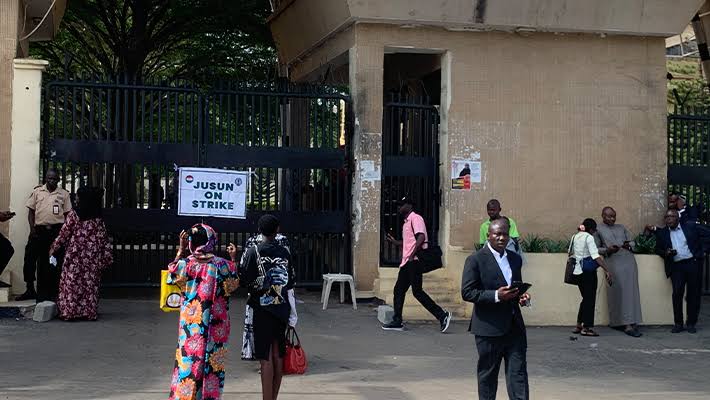
In a surprising turn of events, the Federal High Court in Abuja was abruptly closed on Monday, leaving lawyers, court staff, and litigants stranded outside the premises.
This sudden closure stands in stark contrast to a statement released just a day earlier by court authorities, assuring Nigerians that judicial workers would not be participating in the ongoing nationwide strike.
However, when our correspondent visited the court complex early Monday morning, the gates were firmly locked, and no one—neither members of the public nor legal practitioners—was granted entry. The disruption also extended to the Court of Appeal headquarters in Abuja, where a similar scene unfolded.
The closure follows a communiqué issued on May 30 by the Judiciary Staff Union of Nigeria (JUSUN), directing its federal chapters to embark on an industrial action beginning midnight, June 1, in solidarity with the Nigeria Labour Congress (NLC) and Trade Union Congress (TUC) over ongoing disputes related to minimum wage and electricity tariff hikes.
In the communiqué signed by Acting General Secretary M.J. Akwashiki, JUSUN attributed the strike action to unproductive meetings with the Minister of Labour and Employment.

The demands of the judiciary workers include the payment of a five-month wage award, implementation of the ₦70,000 national minimum wage, and a 25%/35% salary increase.
However, on Sunday, the National Judicial Council JUSUN chapter released a statement through its Public Relations Officer, Mr Joel Ebiloma, announcing that the Supreme Court of Nigeria, the NJC, and the Federal High Court would not be participating in the industrial strike.
The statement explained that the decision followed the intervention of the Chief Justice of Nigeria, Justice Kudirat Kekere-Ekun.
It added that a two-week grace period had been granted to the relevant authorities to address the union’s demands.








 Crime Watch17 hours ago
Police recover bodies of two kidnap victims, arrest suspect in Edo
- News17 hours ago
Jigawa Assembly suspend council speaker over alleged APC anti-party activity
- News1 day ago
Julius Berger completes Bodo-Bonny road
- News17 hours ago
Daily Times Publisher pledges N100m support for NUJ FCT Multipurpose hall project
- News16 hours ago
NDC chieftain Omo-Agege says he supports Obi but still endorses Tinubu reforms
- Personalities Bios1 day ago
Bart O. Nnaji: A trailblazer in engineering, technology, and national development
- News17 hours ago
Gunmen abduct Adelabu’s sister, children in Ibadan
- News1 day ago
Tinubu returns to Abuja after Lagos political tour, Eid celebrations









You must be logged in to post a comment Login