
Foreign Affairs
Trump suspends foreign student visas for Harvard, citing ‘national security’

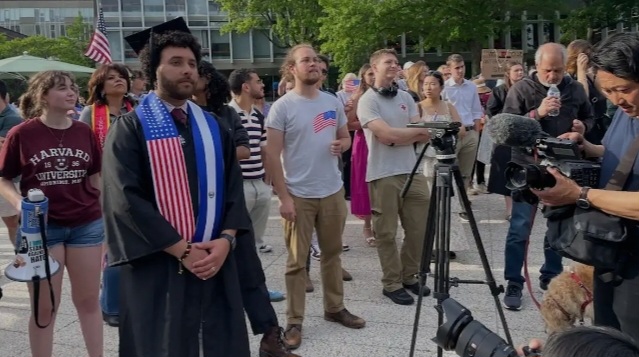
In a striking move that has drawn sharp condemnation from academic circles, President Donald Trump has issued a proclamation suspending the entry of foreign students intending to study or participate in exchange programs at Harvard University for an initial period of six months.
The proclamation, signed on Wednesday, cites unspecified “national security” concerns and deems the continued presence of international students at the prestigious institution as “detrimental” to U.S. interests.
The decision marks a significant escalation in the legal and political standoff between Trump and Harvard, which began earlier this year when the university defied several directives from the Trump-aligned White House.
The nature of those demands has not been officially disclosed but reportedly involved access to research data and changes to administrative protocols related to foreign scholars.
Harvard, in a swift and strongly worded response, denounced the suspension as “retaliatory,” according to the Reuters news agency. The university pledged to “stand by its international students” and said it is reviewing legal avenues to challenge the order.
“This proclamation is a political stunt masquerading as a national security measure,” a Harvard spokesperson said.
“It threatens the principles of academic freedom and undermines the global collaboration that defines modern research and education.”
The suspension, which applies exclusively to Harvard, does not currently affect foreign students attending other U.S. institutions. Legal experts say that targeting a single university in this manner is virtually unprecedented and could face immediate court challenges.

“It’s an extraordinary and almost certainly unconstitutional use of executive power,” said Professor Linda Carlsen, an expert in constitutional law at Georgetown University.
“The administration would have to demonstrate a specific and credible threat, which so far, it has not.”
The announcement has sparked outrage from academic institutions, civil rights groups, and international organizations alike. The American Council on Education called the measure “dangerous and deeply politicized,” while the United Nations Educational, Scientific and Cultural Organization (UNESCO) warned that the order “risks damaging America’s reputation as a beacon for global scholarship.”
Foreign students comprise roughly 25% of Harvard’s graduate population and contribute significantly to its research output. Many also pay full tuition, bolstering university finances.
The economic and academic consequences of the suspension are expected to ripple beyond Harvard’s ivy-covered walls.
With lawsuits already in motion and political pressure mounting, observers say the legal showdown between Harvard and Trump may now become a high-stakes test of how far a former president can go in reshaping U.S. higher education policy—especially when it targets a single institution.
For now, thousands of aspiring international students remain in limbo, caught between geopolitical brinkmanship and their academic dreams.






 News2 days ago
Bandits murder 17 in Sokoto community attack
- News2 days ago
Kidnapped Kaduna schoolchildren, driver regain freedom after 36 days in captivity
- Crime Watch2 days ago
Court sentences 5 men to death for armed robbery, conspiracy
- News2 days ago
I didn’t join APC because of Akwa Ibom deep seaport – Gov Eno
- News2 days ago
Nollywood Veteran actor, Janmole passes away
- Politics2 days ago
House of Reps shake-up as 13 lawmakers defect, Chinda steps down as minority leader
- News2 days ago
NSCDC arrests 39 over illegal private guard company in A’Ibom
- News19 hours ago
Julius Berger completes Bodo-Bonny road









You must be logged in to post a comment Login